
Improved Treatment For Hip Pain
Resolving Common Hip Conditions with Active Release Techniques
Do you experience pain in your hip or groin with walking, standing, or sitting. If so you are not alone. In fact hip pain is a very common problem we routinely see in our clinic.
Although many people hope this pain will go away with a few stretches and some rest this is rarely the case. Instead, most of these conditions get worse over time.
What makes things even more frustrating is the fact that traditional treatments such as medication, massage, modalities such as e-stim or ultrasound, and even stretches and exercises for hip pain are often slow to provide relief.
But there is some good news……
A new treatment technique known as Active Release Techniques (ART) is proving to be a very effective method to resolve common hip problems such as muscles strains, tendonitis, and hip bursitis.
If you’re not familiar with ART treatment don’t worry. This is a relatively new treatment method. So in this article we will discuss the basics of what you need to know about hip pain, including a review of ART treatment.
Here are the key things I will cover….
- The underlying cause of virtually every type of hip problem
- Why traditional treatments are often ineffective or slow to provide relief
- What ART Treatment is… and how is is so effective in treating hip pain
What Causes Hip Pain?
Whenever patients come into our office we like to make sure they have a basic understanding of their problem….. not just their diagnosis, but also what has happened that has caused their problem in the first place. When patients grasp this it is much easier for them to understand what needs to be done to fix the problem.
So lets take a look at how the hip becomes injured in the first place…..
Muscle Strain, Muscle Scarring, and Hip Pain
The hip is a critical joint in the body as it connects the leg to the trunk. As a result there is a tremendous amount of force that must pass through this region with even basic daily activities.
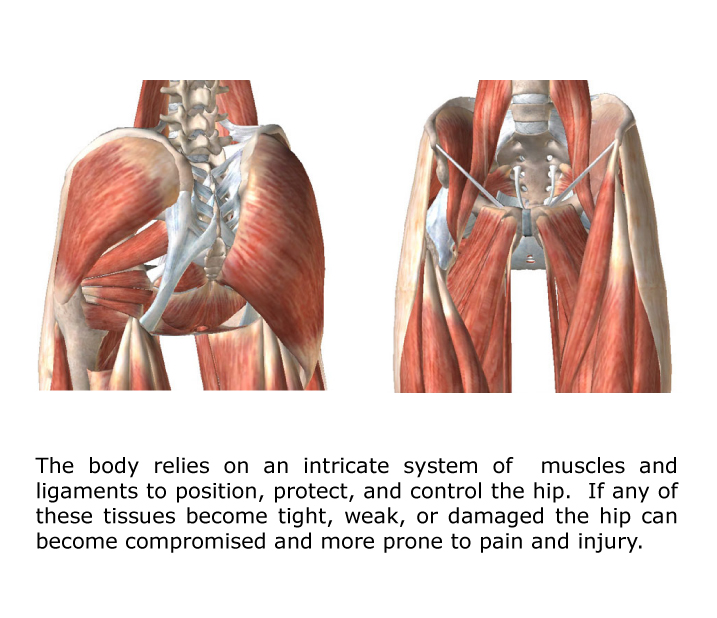
To control and protect the hip joint the body relies on a complex system of muscles and ligaments that surround the joint. In fact, there are 20 specific muscles that directly control the hip.
However most of these muscles are small and have to work hard to control the hip with even basic activities such as walking, bending, or lifting. The demand on these muscles is even greater with physically demanding jobs or athletic activities involving running, lifting, or squatting.
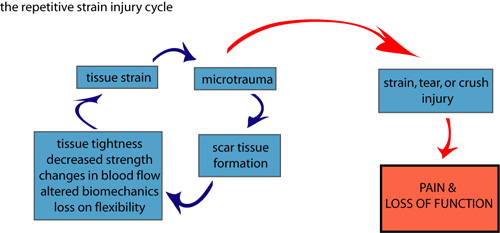
With excessive stress and overuse the various muscles and ligaments of the hip can become strained and fatigued. And over time this strain can develop into small scale tissue damage known as micro-trauma.
Initially this micro-trauma is very small and the amount of damage is not enough be painful. However, this damage still needs to be repaired, which the body does by forming new connective tissue in and around the damaged areas.
This new tissue formation (usually referred to as scar tissue or soft tissue adhesions) itself is not a problem. In fact it is a normal and necessary part of healing. But a big problem does occur when the hip is subjected to the same amount of stress and overload over the course of weeks and months.
When this happens the hip becomes caught in a repetitive strain cycle in which the same muscles and ligaments are damaged and subsequently repaired over and over again. This process is associated with more and more soft tissue adhesion formation around the hip.
Think of these adhesions like rust and grime that can build-up in an car engine. Normally the parts of the engine should be well oiled and move smoothly but when rust and grime are allowed to build-up the car begins to break down.
And just like rust, as these soft tissue adhesions begin to build up in and around the hip it leads to problems such as tightness, muscle weakness and diminished endurance, restricted hip joint motion, and diminished blood flow.
These adhesions are also very sticky and can cause the various muscles of the hip to become stuck together. This will compromise the muscles ability to slide against each other further compromising flexibility and strength.
In many cases these adhesions can even cause some of the nerves of the hip to become stuck against a surrounding muscle or ligament and lead to nerve pain. In fact, it is not uncommon for a nerve entrapment to cause hip pain and lead to an incorrect diagnosis of sciatica, tendonitis, or hip bursitis.
As this repetitive strain cycle continues at some point a symptomatic threshold is reached and hip pain will develop. Although the pain and symptoms associated with most cases of hip pain seem to occur out of nowhere or after a routine activity, you can see that the problem has actually been slowly developing over time and the onset of symptoms is often just the straw that broke the camels back.
Problems with Traditional Hip Pain Treatment
In an attempt to treat hip pain a variety of treatment methods are used. Some of the more common approaches include anti-inflammatory medications, rest, ice and/or heat, ultrasound (US), muscle stimulation (E-Stim), or stretching and strengthening exercises.
Unfortunately, most of these techniques generally require a long period of time before they provide any significant relief and in many cases provide only temporary relief from hip pain….assuming they help at all.
The reason these approaches are often ineffective is they fail to address the underlying scar tissue adhesions that develop within the muscles and surrounding soft tissues. Remember it is these adhesions that are making the hip muscles tight and binding the tissues together.
Passive approaches like rest, ice, medications, and modalities like e-stim primarily focus on symptomatic relief and do nothing to address the muscle restrictions and dysfunction.
More active approaches such as stretching and exercises are often needed for full rehabilitation of the condition and to restore full strength. However, they themselves do not treat the underlying scar tissue adhesions. In fact, without first addressing the scar tissue adhesions stretches and exercises are often less effective and much slower to produce relief or recovery from hip pain.
Improved Treatment for Hip Pain with Active Release Techniques
So if all of these traditional treatments not very successful for hip pain, what is the solution?
Well without a doubt we have found that Active Release Techniques (ART) treatment is the most effective, quickest, and most lasting treatment solution for hip pain.
Active Release Treatment (ART) was developed about 20 years ago by a doctor in the United States. This may seem like a long time but as far as treatment techniques go it is actually quite new – but it is making an big impact in healthcare and is becoming the treatment of choice for many musculoskeletal problems.
In fact, virtually every professional sports team has an ART doctor on staff to help keep athletes healthy and performing at top level. And many major employers have also begun to keep ART doctors on staff to reduce workplace injury.
So let’s take a look at exactly what ART treatment is and why it is so effective if treating hip pain….

What is ART
Active Release is a hands-on treatment method to address problems in the soft tissues of the body, including the muscles, ligaments, fascia, and nerves. What makes ART different from other treatments is that it is specifically designed to identify and treat scar tissue adhesions that build up and compromise tissue health.
By locating and treating the soft-tissue adhesions with ART it allows the doctor to to 1) break-up restrictive scar tissue adhesions, 2) restore normal movement and sliding of the muscles and nerves, and 3) more completely restore strength and flexibility of the muscles which protect and control the hip.
When performing an ART treatment the doctor will first shorten the muscle, tendon, or ligament and then apply a very specific pressure with their hands along that structure. To assess the area the doctor will then stretch and lengthen the tissue underneath their hand contact.
As the tissue slides underneath the contact we are able to assess the texture and tension of the tissue to determine if it is is healthy or contains scar tissue adhesions. When scar tissue adhesions are felt the amount and direction of tension can be modified to break-up the scar tissue and free the problematic area.
ART takes a long time to master and after years of practice ART docs are able to develop a very acute sense of touch and feel. This not only helps us to know exactly which muscles or ligaments have become restricted and damaged, but also helps improve treatment results by allowing us to be very specific with treatment.
This is something that cannot be done with other treatment methods or with stretching or exercises which target the hip muscles in a more generalized fashion.
An additional benefit of ART is that it allows us to further assess and correct problems not only at the hip but also in other areas of the kinetic chain – for example at the the lower back, knee, or foot.
Even if these areas have not yet become painful they can impact how the hip moves and how it is positioned with activities like walking, running, or bending. Clearing problems at these areas will often play a critical role in getting the hip pain to resolve, especially with stubborn or recurrent hip pain.
How Long Does It Take to Resolve Hip Pain?
One of the best things about ART is how quickly results are felt. In our experience the majority of hip pain cases respond very well to ART treatment, especially when combined with the appropriate home stretching and strengthening exercises. Although each case is unique and there are several factors that will determine the length of time it will require to fully resolve a condition, we usually find a significant improvement can be gained in just 3-4 treatments.
Get Relief From Hip Pain
To learn more, or to book an initial appointment to see if ART may be able to help with your hip pain simply call our office at (905) 685-7227 – or book an appointment through our online calendar.
For general questions you can call our office or send us an email at info@graychiropractic.ca – one of our ART certified doctors will be happy to answer any questions you may have.