
Resolving Shoulder Pain
What You Need To Know About Our Approach To Care
Hi, I’m Dr. Jason Gray. I’m the founder of My Rehab Connection, and I’m also a chiropractor at Gray Chiropractic Spine and Joint Clinic in St. Catharines, Ontario.
Here I want to talk to you about shoulder pain. More specifically, I want to talk about non-traumatic shoulder pain, as this is what I primarily treat. Examples here would include things like rotator cuff strains and tendonitis, bursitis, shoulder impingement syndromes, and myofascial shoulder pain syndromes.
Unlike acute or traumatic pain, where the injury occurs suddenly and all at once, these conditions aren’t caused by any one thing in particular. Instead, they tend to sneak up on us. Symptoms just show up one day for no obvious reason. Or, if there is a trigger, it’s often something routine that we’ve done countless times before and would never expect to cause a problem — things like exercising at the gym, reaching into a cupboard, or lifting a bag of groceries into the trunk of the car.
It’s important to take a moment to explain why this happens, and what’s actually causing these issues, because it makes a big difference in how we go about treating this type of pain.
And one of the most critical things to recognize is that with these shoulder conditions, we don’t just have one problem — we actually have two. Let me explain.
What Causes Shoulder Pain?
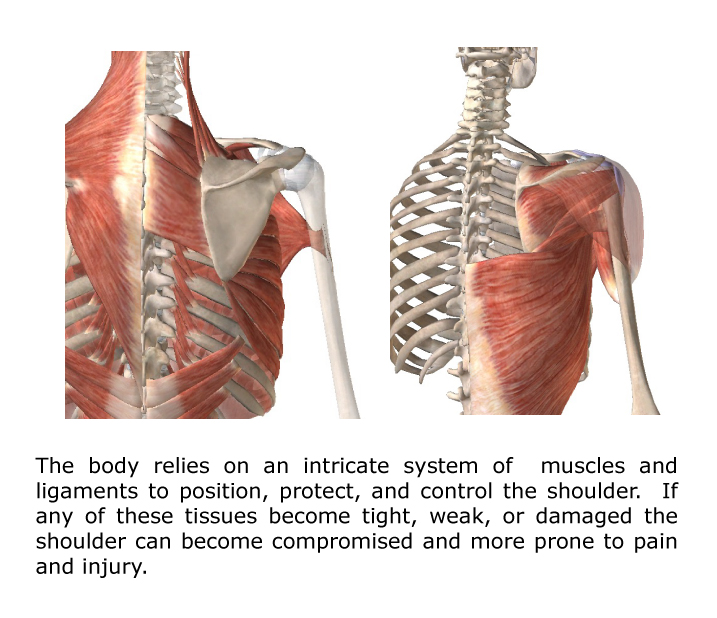
Non-traumatic shoulder pain doesn’t start out as an injury. It starts with things like subtle muscle weakness, limited flexibility, or muscle imbalances around the shoulder.
At first, these subtle problems go unnoticed, because your body is very good at compensating. But these compensations have a way of catching up with you, because they create abnormal stress patterns and microtrauma in and around the shoulder. As these compensatory movement patterns continue, that stress and microtrauma can develop into larger-scale injury and pain. This is what happens in most cases of shoulder pain.
For example, if one of the four rotator cuff muscles is tight or weak, it places excessive strain on the others — this can eventually progress to tendonitis or myofascial pain. If shoulder flexibility is limited, it affects how the upper arm moves and glides within the joint socket, which is a common cause of shoulder impingement syndrome. In other cases, the body compensates for restriction at the shoulder by increasing motion at the shoulder blade. This may reduce overload at the ball-and-socket joint, but it often comes at the cost of myofascial pain around the shoulder blade instead.
Non-traumatic shoulder pain doesn’t start as an injury — it starts with small strength and flexibility deficits that go unnoticed until the body’s compensations catch up with it.
Two Problems, Not One
So, as I said, when dealing with non-traumatic shoulder pain we really have two problems.
We have the damaged muscles, tendons, or ligaments that are causing the pain itself. These injured tissues need to be addressed and rehabilitated. But the problem is bigger than this, so we can’t focus on the pain alone. We also need to address the underlying strength and flexibility deficits and muscle imbalances around the shoulder that caused the microtrauma and overload in the first place.
This is the real reason so many shoulder conditions seem to linger, or keep coming back again and again — the treatment isn’t addressing the whole problem. It’s missing the root cause.
Treatment For Non-Traumatic Shoulder Pain
Hands-On Care: Treating Shoulder Pain With ART and FR Tissue Release
Now let’s talk about how we go about treating non-traumatic shoulder pain, starting with the hands-on treatment done in the clinic.
We need a way to very specifically address the scarring and restrictions that accumulate with overuse and microtrauma in the muscles that surround the shoulder and shoulder blade. My primary go-to treatments here are specialized techniques such as Active Release Technique (ART) and Functional Range Release (FR Release).
These are both hands-on soft tissue manipulation techniques that allow me to create a powerful stimulus to affected muscles, fascia, and ligaments, helping to release tight, damaged, and scarred tissue. That means these techniques are effective both at promoting tissue healing and at releasing tight muscles and ligaments that are restricting flexibility and normal shoulder motion.
Because these are hands-on treatments, one of their most powerful benefits is that they allow me to target muscles in a very direct and specific way — reaching the deep muscles that surround and control the shoulder far better than you could on your own. That’s why these are the primary techniques I use when treating non-traumatic shoulder pain.

Shoulder Rehabilitation: Your Home Exercise And Movement Routine
As effective as ART and FR treatment can be, it alone won’t be enough. Every patient I see is prescribed home stretches and exercises tailored to their specific condition.
These exercises need to do more than promote healing of the injured tissue — they also need to address the underlying causes of that damage. As we discussed, all of these conditions involve some underlying muscle weakness, imbalance, or faulty movement pattern at the root of the problem.
But a big challenge in addressing these underlying issues is that they’re unique to each patient. There isn’t one specific abnormal movement pattern that leads to rotator cuff tendonitis, bursitis, or shoulder impingement — the underlying imbalances are different for each person. That’s why the stretches and exercises need to be customized and tailored to the individual. And the only way to understand the specific strength or flexibility impairments unique to each patient is to go and find them.
There is no single movement pattern behind rotator cuff tendonitis, bursitis, or shoulder impingement. The underlying imbalances are unique to each patient — which is why generic exercise routines so often fall short.
A Proper Assessment Is Critical
When I see non-traumatic shoulder conditions in my clinic, I take every patient through a full exam. I want to know not just what hurts and needs to heal, but every mobility limitation, imbalance, and weakness that also needs to be addressed.
It’s this testing that allows me to develop a very specific home stretching and exercise plan tailored to each individual patient.
So for each patient, I take the time not only to customize these exercises, but to be very particular about how they’re performed. We can’t afford to reinforce the same movement and muscle compensations that caused the problem in the first place. We need to do the right exercises, the right way, at the right time, with the right effort and intensity, to accomplish our goals. So it’s my job to help you know what you need to do — and then it’s your job to do it.
To help you with these exercises at home, I set all my patients up on My Rehab Connection, a free app I created that gives you access to written instructions, pictures, and video for your exercises at home.
But Consider This Before You Make An Appointment
If this approach sounds like it would be helpful for a shoulder condition you may be having, call my office and my staff will walk you through making an appointment.
But before you pick up the phone, I want you to keep a few things in mind.
First, while I believe the approach I’ve outlined here offers the most complete treatment solution, please understand it’s not a quick fix. Tissue healing, and building flexibility, strength, and muscle balance, takes time — and it takes work and effort.
Every patient and every condition is unique, so I can’t tell you exactly how long treatment for your specific case will take. That said, typical treatment plans often fall in the 6-8 week range. In terms of in-office care, treatments are typically scheduled twice a week initially, then reduce in frequency in the latter half of the plan. In terms of home exercise requirements, plan on around 20-30 minutes a day.
So please consider this, and if your schedule doesn’t allow for it, you may need to rethink this approach to care.
Are You Ready To Get Relief From Shoulder Pain?
To learn more, or to book an initial appointment to see if ART may be able to help with your shoulder problem, simply call our office at (905) 685-7227 – or book an appointment using our online calander. For general questions you can either call our office or send us an email at info@graychiropractic.ca – we will be happy to answer any questions you may have.