
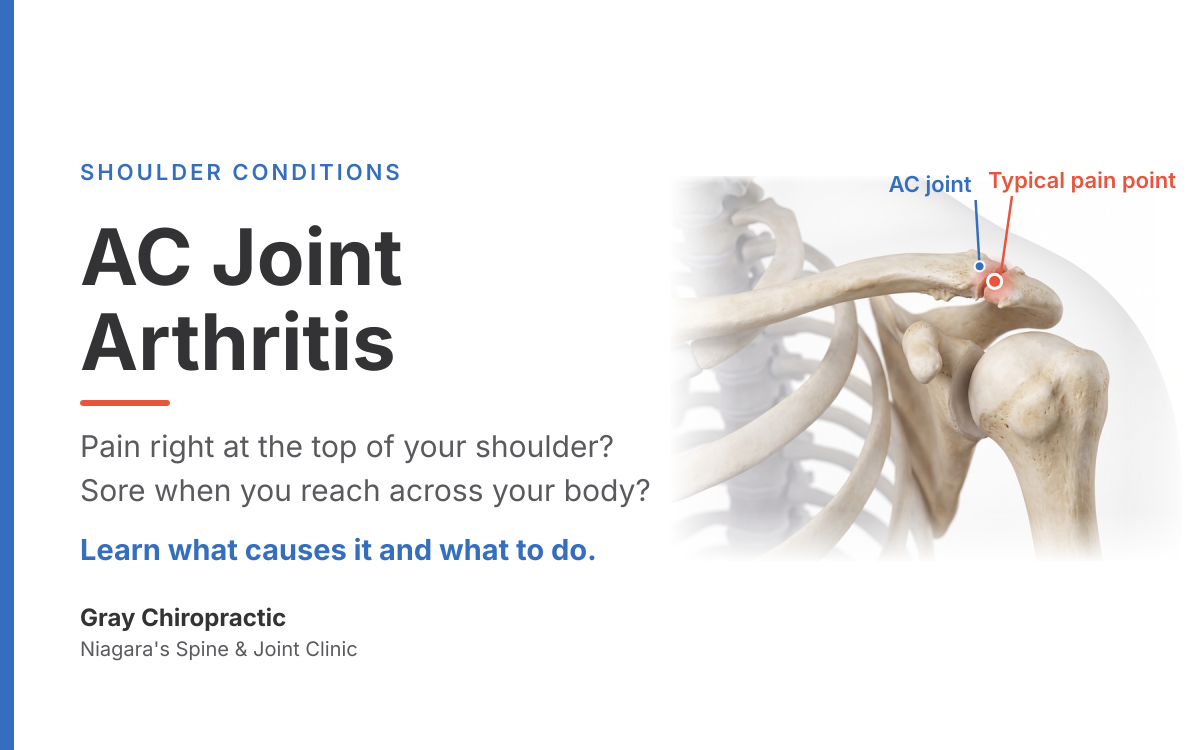
You have a pain right at the top of your shoulder, in a spot you can almost point to with one finger. It’s usually where the collarbone meets the shoulder, and it may be tender to press. It flares when you lift your arm overhead, reach across your body, push or press, or lie on that side at night. Your shoulder may also feel stiff or achy afterward. It crept up slowly, and you can’t think of an injury that started it.
This pattern is common with AC joint osteoarthritis, commonly called AC joint arthritis. It is a gradual wearing of the cartilage in the acromioclavicular (AC) joint, the small joint at the top of the shoulder where your collarbone meets your shoulder blade.
What Is AC Joint Arthritis?
Understanding what is happening in the joint is the key to managing it.
The AC joint is small, but it works hard. It moves a little every time you raise or reach your arm, and it gets stressed whenever you lift, push, or carry. In osteoarthritis, the cartilage in this joint gradually thins and roughens, and the joint becomes stiffer and more irritable. It is common, it tends to develop slowly, and it can be influenced by things like age, past injuries, and how the joint has been used over the years.
We want to be honest and direct about this: arthritis is not a condition we can make go away. But there is a lot that can be done to (1) help manage your symptoms and reduce pain, and (2) help slow the progression of the problem.
Why Motion Matters So Much
Like other joints, the AC joint has no direct blood supply. It depends on the fluid inside the joint space (the synovial fluid) to deliver the nutrients and building blocks that keep the cartilage healthy.
That fluid is stimulated by movement. As the joint capsule stretches with motion, the cells that line it produce more synovial fluid. In short, movement is what feeds the joint.
This creates a downward spiral. As an arthritic joint becomes stiffer and tighter, it moves less. Moving less causes more pain and stiffness, and it also takes away the very stimulus the joint needs to stay healthy. Then the joint becomes stiffer still, and the cycle continues.
The AC joint is also affected by what happens around it. When the shoulder blade, collarbone, and upper back aren’t moving well, or the muscles around them are tight or weak, more stress lands on this small joint with every movement.
Our Approach: Improve and Manage
Because the problem is a downward spiral, our approach is to break it. We focus on improving and maintaining motion in and around the joint, so it gets the stimulus it needs and takes less stress, and you can keep doing the things you enjoy.
So in our clinic, we perform a thorough exam to find out how your shoulder, shoulder blade, and upper back move, which muscles and joints are restricted, and where weakness or poor control is adding to the problem. Then we build your plan around improving motion and keeping it. This includes:
- Active Release Technique (ART): a hands-on soft tissue method that releases tight, restricted muscles around the shoulder, shoulder blade, and upper back that limit motion and are hard to reach on your own
- Home exercises: to improve and maintain your shoulder motion and to strengthen the muscles that support the shoulder blade and joint. The exercises have to be matched to your joint, challenging enough to be effective but not so hard that they flare it up, and progressed over time. That is why a customized program works better than generic exercises from YouTube or TikTok.
The goal is not a quick fix. It is to help you feel better, move better, and give your shoulder the best chance of staying that way.
What to Expect
Your first visit. We take a full history and perform a detailed exam. This confirms your diagnosis and shows us how your shoulder is moving. Only then do we build your treatment plan.
Timeline. Because arthritis is managed rather than fixed, treatment looks a little different. Most plans start with about 6-8 weeks of regular treatment to improve motion and settle symptoms, though this varies from person to person. After that, many people continue with occasional visits and their home exercises to maintain their progress.
Visits. Hands-on treatments like ART can’t be done at home, so we see you in the office, usually twice a week at first, then less often as you progress.
Home exercises. Your program is prescribed in our office but done at home, typically about 30 minutes a day at the start. Please consider this commitment before booking. Because motion is what protects the joint, the exercises are the most important part of managing your shoulder over the long term.
When Should You Get It Checked?
It’s worth having your shoulder assessed if:
- You have pain at the top of your shoulder that has lasted more than a couple of weeks
- Lifting overhead, reaching across your body, or pushing hurts
- Lying on that shoulder at night is uncomfortable
- It’s starting to affect sleep, exercise, or work
Arthritis is easier to manage when it’s addressed early, because the better your shoulder moves now, the more motion you have to protect.
Seek urgent medical care instead if you have chest pain, shortness of breath, or pain spreading into your jaw or left arm. Also seek care if you have a sudden loss of strength or can’t move your arm after a fall or injury, if there is a new bump or deformity at the top of your shoulder, or if you have significant swelling or bruising. Sudden severe pain with redness, warmth, or fever also needs prompt attention, since an infected joint needs medical care.
Ready to Get Started?
If pain at the top of your shoulder has been hanging around, we can help you find out what’s going on and build a plan to keep you moving. Book your appointment here or call us at (905) 685-7227.