
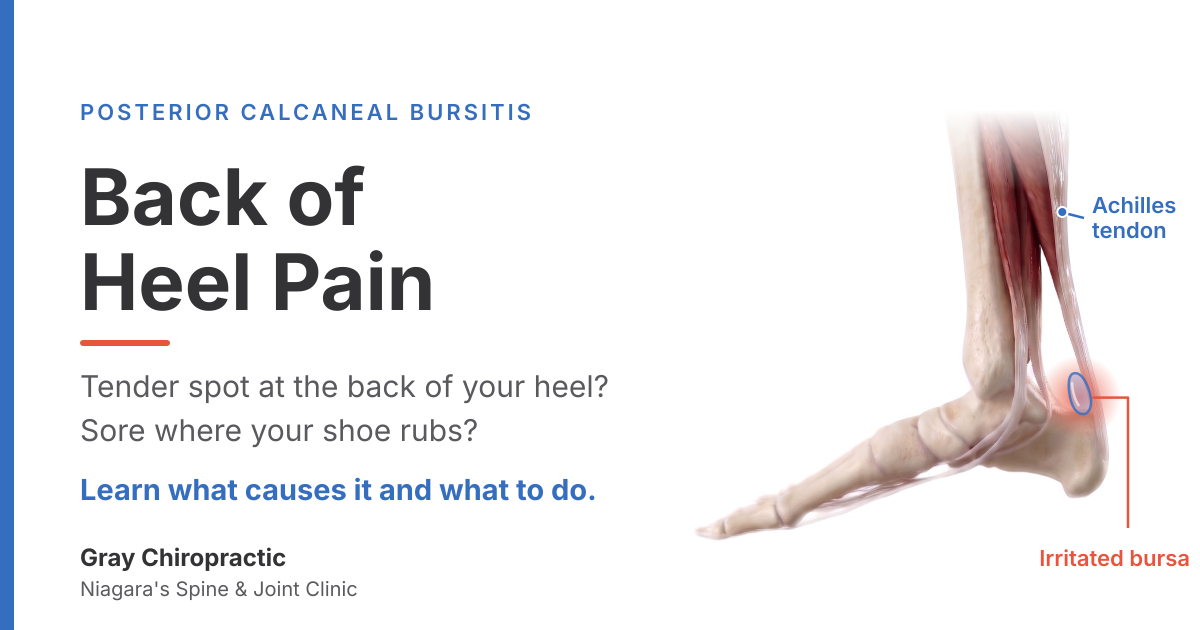
The back of your heel is tender and sore, especially when you press on it or wear certain shoes. It may feel stiff in the morning, ease up as you move, then flare again later in the day. Sometimes there’s a bit of swelling or a tender bump. You can’t think of an injury that started it. It just began and won’t go away.
This pattern is common with posterior calcaneal bursitis, an irritation of the small fluid-filled cushion (the bursa) at the back of your heel, right next to where the Achilles tendon attaches.
Pain under your heel or in your arch instead? Read about plantar fasciitis.
What Causes Posterior Calcaneal Bursitis?
Understanding the cause is the key to getting better.
A bursa is a cushion that reduces friction between a tendon and bone. At the back of your heel, it sits between the Achilles tendon and the heel bone. When it’s repeatedly squeezed or rubbed, it becomes irritated, swollen, and painful.
So the real question is: why is it getting squeezed or rubbed? In most cases the answer is mechanical. This is a repetitive strain injury, meaning stress that builds up slowly over time rather than from one event. It often starts with small problems in how the foot and ankle move, such as:
- A stiff ankle or tight calf
- Stiff or restricted joints in the foot
- Muscle weakness
At first you don’t notice these problems because your body compensates. But the compensation changes how your foot and ankle move, and it increases pressure and friction at the back of the heel. Over time, the bursa takes the brunt of it.
The bursa and the Achilles tendon often get irritated together. The bursa sits right beside the point where the Achilles attaches to the heel bone, so the two commonly flare up at the same time. When the tendon is involved, it’s called insertional Achilles tendinopathy. You can read more about it here: Achilles tendinopathy
Our Approach: Restoring Proper Mechanics
Here’s what’s often missed: the bursa is usually the victim, not the cause. Most people focus only on the sore spot, using rest or padding to ease the pain. That can help for a while, but if the mechanical problems creating the pressure are still there, the bursa keeps getting irritated. That’s why this condition can be so stubborn and keep coming back.
Our approach is to take the stress off the bursa by restoring proper mechanics. We perform a thorough exam to identify the specific muscle and joint restrictions and weaknesses behind your problem, then make correcting them the core of your treatment plan. This includes:
- Active Release Technique (ART): a hands-on soft tissue method that releases tight, restricted muscles in the calf and foot that are hard to reach on your own
- Joint manipulation: to restore normal movement to stiff joints in the foot and ankle, when appropriate
- Home stretches and exercises: to maintain your progress and strengthen weak areas
If the Achilles tendon is also involved, we treat it as well. That means:
- Shockwave therapy, which helps stimulate tissue healing. Research shows it can be an effective treatment for tendon problems. (This is especially important when insertional Achilles tendinopathy is also present. Learn more here: Achilles tendinopathy)
- Progressive loading exercises, which are the foundation of tendon rehab. The exercises have to be challenging enough to trigger healing but not so hard that they flare the tendon up. That balance is why a customized program works better than generic exercises from YouTube or TikTok.
What to Expect
Your first visit. We take a full history and perform a detailed exam. This confirms your diagnosis and uncovers what is driving the problem in your case. Only then do we build your treatment plan.
Timeline. This is not a quick fix. Irritated tissues take time to settle and heal. We can help them recover faster and better, but most plans run about 6-8 weeks, and longer if the Achilles tendon is also involved. This varies from person to person.
Visits. Hands-on treatments like ART, joint manipulation, and shockwave can’t be done at home, so we see you in the office, usually twice a week at first, then less often as you progress.
Home exercises. Your program is prescribed in our office but done at home, typically about 30 minutes a day. Please consider this commitment before booking, since the exercises are a big part of why treatment works.
When Should You Get It Checked?
It’s worth having your heel assessed if:
- The pain has lasted more than a couple of weeks
- It improves with rest but keeps coming back
- It’s starting to affect walking, exercise, or work
- There’s a tender bump or swelling at the back of your heel
Heel problems are generally easier to treat when they’re caught early, before months of compensation have built up.
Seek urgent medical care instead if you felt a sudden pop or snap, can’t put weight on your foot, or have significant swelling with redness, warmth, or fever. An infected bursa needs prompt medical attention.
See How We Treat It
Here’s a short video on how we assess and treat foot pain in our office.
Ready to Get Started?
If back-of-heel pain has been hanging around, we can help you find the cause and build a plan to fix it. Book your appointment here or call us at (905) 685-7227.